-
Booth S22
June 16 - 21, 2026
-
Violeta Maya
Violeta Maya (b. 1993, Spain) works across painting, interaction, and moving image, developing a practice grounded in time, process, and transformation. Her approach combines sequential thinking with intuitive responsiveness, allowing each work to unfold in relation to the next and forming a continuous visual field rather than a series of discrete compositions. Painting, in this sense, becomes a durational act in which rhythm, accumulation, and change function not only as formal devices but as structures through which the work emerges. Her paintings evoke shifting atmospheres in which colour and gesture register states of emergence, tension, and flux.
This focus extends into her handling of materials, where the balance between control and contingency becomes central. Working primarily with wet-on-wet techniques on unprimed canvas, Maya allows pigments to spread, absorb, and interact beyond complete control, treating material behaviour as an integral part of the work’s formation. The resulting surfaces hold a dynamic tension between intention and unpredictability, foregrounding process and material responsiveness as central to meaning. Expanding into multi-panel works and sculptural forms inspired by Japanese screen traditions, she introduces permeability and spatial interaction, reinforcing an ongoing interest in continuity, movement, and the blurring of distinctions between painting, object, and environment. -
-
Eduardo Terrazas
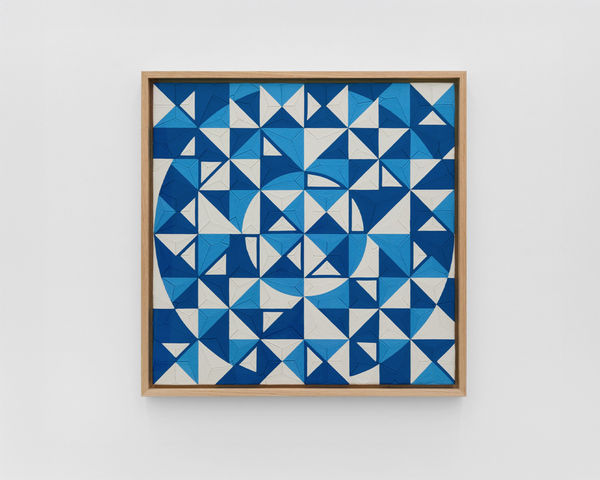
Eduardo Terrazas (b. 1936, Mexico) draws from a geometric language and a method inspired by the tablas of the Huichol, an Indigenous Mexican tribe. Using symmetrical structures as matrices for countless variations, Terrazas explores cosmic concepts, placing the earth at the center and the celestial dome at the periphery, while essential forces – gravitational, electromagnetic, and nuclear – compete for the space in between.The technique involves affixing colored wool onto wooden panels coated with Melipona bee wax, acting as an adhesive. The thread moves along, reproducing the lines, curves, meanders, and changes of direction required by the motif. This process entails tirelessly repeating back and forth movement, during which each strand is tightly glued along the previous one, leaving no gaps or openings between them. -
-
-
-
Lea Porsager
Lea Porsager's (b. 1981, Denmark) prismatic Chakra Mills bring together different technologies and symbolic systems: the water mill and New Age references to chakras, tarot, and numerology. Each mill corresponds to a specific energy center. They are not designed to turn or function mechanically; rather, they originate from a larger body of work in which everything is frozen, paralyzed, and numb.This work sits in the slipstream of Porsager’s longstanding fascination with wheels, turbines, and mills – technologies of circulation, transformation, and energy. Together, the Chakra Mills extend her ongoing exploration of movement, power, and symbolic systems, while suspending these forces in a state of arrested motion. -
-
Carlos Amorales
Carlos Amorales (b. 1970, Mexico) is a multidisciplinary artist who explores the limits of language and translation systems to venture into the field of cultural experimentation. He uses graphic production as a tool to develop linguistic structures and alternative working models that allow new forms of interpretation and foster collectivity. In his projects, Amorales examines identity construction processes, proposes a constant re signification of forms present in his work, and provokes a clash between art and pop culture.
Fragmented Star (Typographical) 09 (2023) is a collage composed of painted cardboard cut-outs on linen. The work continues Amorales’s investigation into abstraction, fragmentation, and visual language. The cut shapes echo typographic forms – familiar yet unreadable – suggesting a language stripped of semantic meaning. Through rhythm, colour, and spatial arrangement, Amorales proposes an alternative mode of communication rooted in intuition and visual perception. The work builds on earlier series in which collage and repetition function as tools for exploring the limits of language and understanding. -
-
Torbjørn Rødland
Torbjørn Rødland’s (b. 1970, Norway) photographs are produced through film-based cameras and chemical processing. His self-aware and often uncanny photographs, films, and books are saturated with symbolism, lyricism, and eroticism. They take on existing visual forms and genres from still lives to portraits to landscapes, but without the research tone of first-wave conceptual art or the ironic commentary of the subsequent Pictures Generation.In his work, Rødland attempts to seize and integrate truth, rather than deconstruct it, reflecting his inclination to delve into the problematic aspects of contemporary photography and the history of art. He probes popular visual languages in search of both spiritual and perverse qualities, aiming to prolong our engagement with both still and moving images. His works do not offer quick readings; instead, they invite us to explore the layered nature of each image, encouraging personal interpretations based on our cultural, political, and personal contexts. -
-
Tove STorch
Tove Storch’s (b. 1981, Denmark) artistic practice has for many years centered around textile structures – especially transparent silk organza stretched across wooden or metal frames. At times the silk is pulled so tightly that the frames bend under the tension, while at others it is loosened, allowing the material to fall in soft, slumping arches. Through these investigations of tension, gravity, and transparency, Storch explores how fragile materials can produce both spatial and bodily associations, balancing formal abstraction with something intimate and tactile.
Untitled (2026) originates from the idea of upscaling a piece of textile. Suspended within a transparent plexiglass box, fine threads stretch repeatedly between wooden supports, forming draping curves that yield to their own weight. The dense repetition of lines recalls weaving techniques and enlarged textile fibers. As the threads fall into soft arcs between fixed points, the rigid framework appears unexpectedly fluid and delicate. The work transforms simple linear materials into a luminous, almost immaterial structure, where transparency, gravity, and rhythm create a sculptural drawing in space.
-
-
Ikram Abdulkadir
Ikram Abdulkadir (b. 1995, Kenya) is a Swedish-Somali photographer based in Malmö, working within a documentary photographic tradition. Her photographs emerge from close relationships with the people and environments around her, portraying sisters, friends, and members of her community in everyday urban and domestic settings. Through a quiet and attentive visual language, Abdulkadir explores intimacy, friendship, sisterhood, and belonging, often focusing on subtle gestures and exchanges that shape shared experience.
Working from her own lived experience as a Black Muslim woman in Scandinavia, Abdulkadir reflects on questions of visibility, self-definition, spirituality, and community. Approaching the camera as both participant and observer, she creates images grounded in trust and mutual recognition, considering how personal and collective histories are carried through presence, environment, and emotional connection. -
-
Matthew Ronay
Matthew Ronay's (b. 1976, USA) dyed basswood sculptures invite viewers into a realm where tangible forms intertwine with metaphysical energies. Rooted in automatic drawings, his works tap into deeper layers of consciousness, unveiling hidden aspects of the psyche.
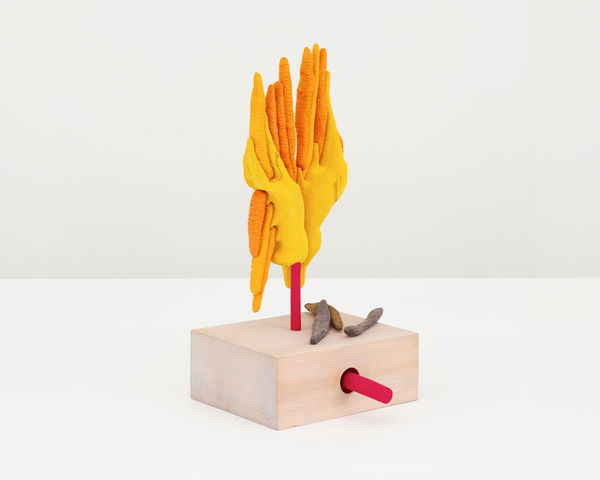
Succuloid (2019) leaves viewers uncertain: Is this an underwater formation, a plant-like structure, or perhaps something not carbon-based at all? By deconstructing context, Ronay creates parables of the family, ultimately challenging perceptions of reality. This interplay reveals the core of his artistry, grounded in a profound understanding of form. Seemingly disparate objects come together in a surprisingly synthesized way, immersing viewers in a tactile experience that prompts reflection on the interconnectedness of humanity and the natural world. -
-
Davide hjort di fabio
Davide Hjort Di Fabio’s (b. 1990, Italy) sculptures emerge through processes of casting, repetition, and material transformation. Often beginning with fragments of his own body, the works move away from direct representation and become unfamiliar forms that sit between the bodily and the architectural, the intimate and the constructed. Rather than presenting the body as fixed or complete, his practice explores it as something in constant transition – shaped through memory, sensation, and its surroundings.
In Sleepwalker (2026), a glazed stoneware form originating from a cast of the artist’s torso rests on stacked perforated ceiling panels sourced from hospital interiors. Through processes of reshaping and transformation, the body becomes abstracted into a dense yet soft form that appears held, compressed, or slowly changing shape. The support structure introduces an architectural language associated with care, waiting, and institutional space, while the sculpture resists clear identification. Together, the elements create a tension between vulnerability and containment, where the body appears less as an image than as a shifting condition.
-
-
Rebecca Lindsmyr
Rebecca Lindsmyr’s (b. 1990, Sweden) work traces the fragile systems through which subjectivity and meaning are organized. In manage your password safely, the ongoing maintenance of a personal symbolic system becomes both the work’s subject and the principle that structures its making. Managing passwords – repeating them, changing them at precise intervals, juggling your own secret symbolic marks – has become an incessant feature of contemporary life. Capturing this sense of displacement and exhaustion, the work contains the digital translation of a handmade mark, repeatedly performed via screen printing. Its rasterization proposes a loss of information; a loss recurring in the construction of the work. Made through repeated layering, where parts of the surface have been blocked, the painting suggests an inability to perform as image or complete surface. Instead, it emerges through cycles of repetition and interruption, revealing fragments of what lies beneath its layers.
The work connects to Lindsmyr’s ongoing contemplations on the implications of the expressive mark and the reconfigurations of subjectivity, filtered through a process-oriented painterly approach. -
For general inquiries, please contact: inquiry@nilsstaerk.dk