The gallery’s second presentation as part of focus26 features two works by Runo Lagomarsino, both first shown in 2024 in his solo exhibition Silence Answers All at Marabouparken Konsthall, Sundbyberg, Sweden. Together, they examine how images travel through history, how they accumulate meaning, and how acts of repetition, intervention, and reinterpretation can reactivate their political force.
At the core of Lagomarsino’s film Elementary is Picasso’s Guernica, painted in Paris in 1937 during the Spanish Civil War after the bombing of the Basque town of the same name. Originally presented in the Spanish Republic’s pavilion at the Paris World Fair only weeks after the attack, the painting has since become one of the most enduring visual indictments of war.
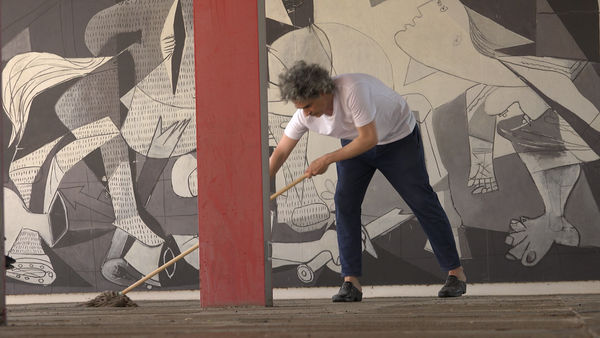
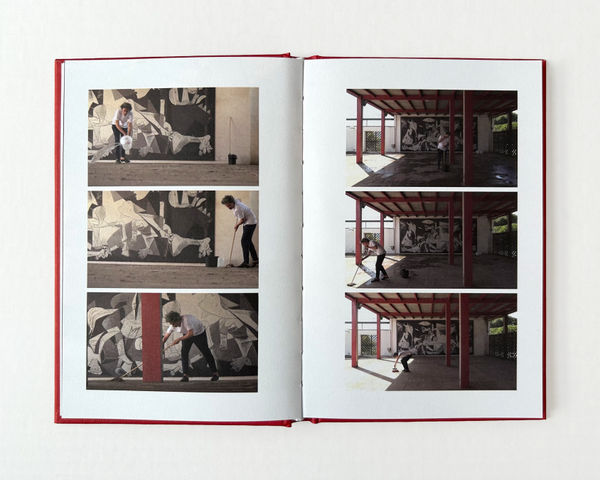
A replica of that pavilion, built in Barcelona in 1992, now houses the CRAI Biblioteca Pavelló de la República, which holds an extensive archive on the Spanish Civil War alongside a reproduction of Guernica installed as it was in 1937. In Lagomarsino’s film, this reproduced image forms the backdrop for a simple, repetitive gesture: the artist sweeping and mopping the floor beneath it. The steady rhythm of cleaning evokes the deep marks history inscribes upon collective memory. If Guernica condemns the horrors of war, the act of washing away dust and dirt underscores the impossibility of erasing the past. The image persists, continuing to haunt.
This tension between image, language, and political action is echoed in Kill All Lies, All Lies Kill, Lies Kill All. The work draws on a charged episode from 1974, when Tony Shafrazi spray-painted text across Guernica at MoMA, intending to write “LIES ALL KILL,” a phrase from James Joyce’s Finnegans Wake, as a protest against the Vietnam War. Misjudging the spacing, he added “KILL” before the other words; the inscription was quickly removed, yet the gesture entered art history as an ambiguous act of dissent.
Lagomarsino’s drawing reconfigures this phrase into shifting sequences, layering its words into unstable formations that foreground the volatility of meaning. The work invites viewers to consider how language operates as both weapon and witness, and how art can function as a site where truth, power, and resistance collide.
 Photo: Krzysztof Zielinski